
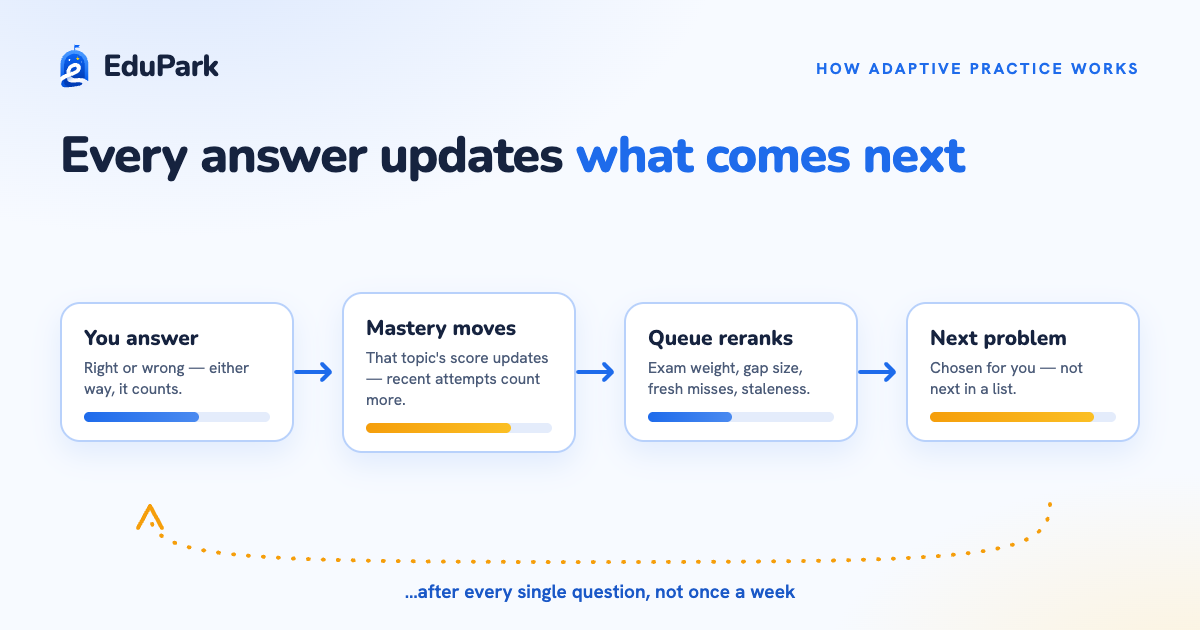
How does adaptive SAT practice work? The app tracks a mastery score for every topic you practice, updates that score after every question you answer, and uses it to build your next practice session.
Isn't the SAT itself adaptive?
Yes, but not in the way a prep app means when it calls itself "adaptive." The digital SAT is two-stage adaptive per section: how you do on Module 1 of a section determines whether you get an easier or harder Module 2 for that same section, and the easier Module 2 caps how high that section can score. It happens once per section, on test day, based only on how that day's Module 1 went.
Side by side with what a prep app means:
| The adaptive SAT test | Adaptive SAT practice | |
|---|---|---|
| What adapts | Module 2's difficulty | Which problems go into each session |
| When | Once, mid-exam, on test day | Session by session, across weeks of prep |
| Based on | Your Module 1 performance | Your whole practice history |
| Its job | Score you efficiently | Close your gaps before test day |
EduPark's full-length mock exams follow the left column, with Module 1 to Module 2 routing and the same format as test day, so the real exam's adaptivity isn't a surprise when you meet it. The rest of this article covers the right column.
What the mastery score is
Every question you answer updates a mastery score for the topic that question belongs to. The score comes from your recent answers on that topic, adjusted for how hard those questions were, so the same accuracy on harder questions earns a higher score. Older answers drop out as new ones come in, so a mistake from three weeks ago stops holding you back once you've fixed the gap.
How your next problems get picked
What goes into your next session isn't random, and it isn't the fixed syllabus order you'd get from a textbook. It's built in two steps. First, your topics are ranked on four things:
- How much the topic matters: its actual weight on the real exam
- How far your mastery sits from solid: the size of the gap
- Whether you've missed it recently: fresh mistakes jump the queue
- How long since you last touched it: so a topic you nailed once doesn't quietly vanish from your practice forever
Then, within each topic, the difficulty is set from how you're doing on it: the higher your accuracy there, the harder the problems you get. Problems you've already seen are left out.
Compare that to a static question bank. Nothing there is watching what you just got wrong and reordering anything in response. You could ace a topic on question one and still get ten more of the exact same type before the bank moves on, purely because that's the order they were loaded in.
Here's an example of a question you might see. In EduPark, how you do on a question like this feeds the mastery score that shapes your next session.
The area, in square meters, covered by lily pads on a pond is modeled by the function
Show step-by-step walkthrough
-
Identify the Model
We're given an exponential growth model
and asked how many days it takes for the area to double. To find the doubling time, we first need the initial area — the area when . Growth and decay models — In exponential growth models of the form A(t) = A₀ · bᵗ, the initial value A₀ is found by substituting t = 0.
-
Set Up the Equation
"Double" means twice the initial area. Since the initial area is
square meters, the doubled area is . We set and solve for . -
Solve for d
Divide both sides by
to isolate the exponential term. Once both sides share the same base of , we can equate the exponents — this is the key technique for solving exponential equations when the bases match. -
Verify
Plug
back into the original function. We should get exactly (double the initial area of ). It checks out — Choice B is correct. Growth and decay models — Growth and decay models
Why this answer is right
B
Setting
In an exponential model
Why the other choices are traps
-
A
A student might see the base
in and assume the doubling time is days. But the base tells you the growth factor, not the time. Plugging in gives , which is not double the initial area. Confusing the base of the exponential (the growth factor) with the doubling time.
-
C
A student might mistake the coefficient
for the doubling time, since is the most prominent number in the function. But is the initial area, not a time value. Plugging in gives , which is more than double. Confusing the initial value coefficient with the growth rate or period.
-
D
A student might think doubling means multiplying the period by
, computing . Plugging in gives , which is four times the initial area — the area has doubled twice, not once. Thinking 'doubling time' means doubling the exponent denominator, rather than solving for when the function output doubles.
Expert tips
For any function in the form
, the quantity multiplies by every time units. Here, and , so the area doubles every 3 days. You can read the answer directly from the formula without any algebra. When a problem asks "how long to double," look at the exponent's denominator and the base. If the base is already
, the denominator of the exponent fraction IS the doubling time — no calculation needed. Think of exponential growth models as having three parts: the initial amount (coefficient), the growth factor (base), and the period (denominator in the exponent). Each part answers a different question: how much to start, by how much each cycle, and how long each cycle takes.
What changes after each session
After a practice session or a full mock exam, your recommendations reshuffle around where you stand right now: a rough session pushes the topics you missed to the front, and a strong one moves the next-weakest topic up instead of repeating what you've already proven.
Adaptive practice means the tool reacts to you rather than the other way round: every answer updates your mastery, and every session reshapes the next one. That's the loop.
Practice with free SAT questions that adjust to how you answer.
Start free