
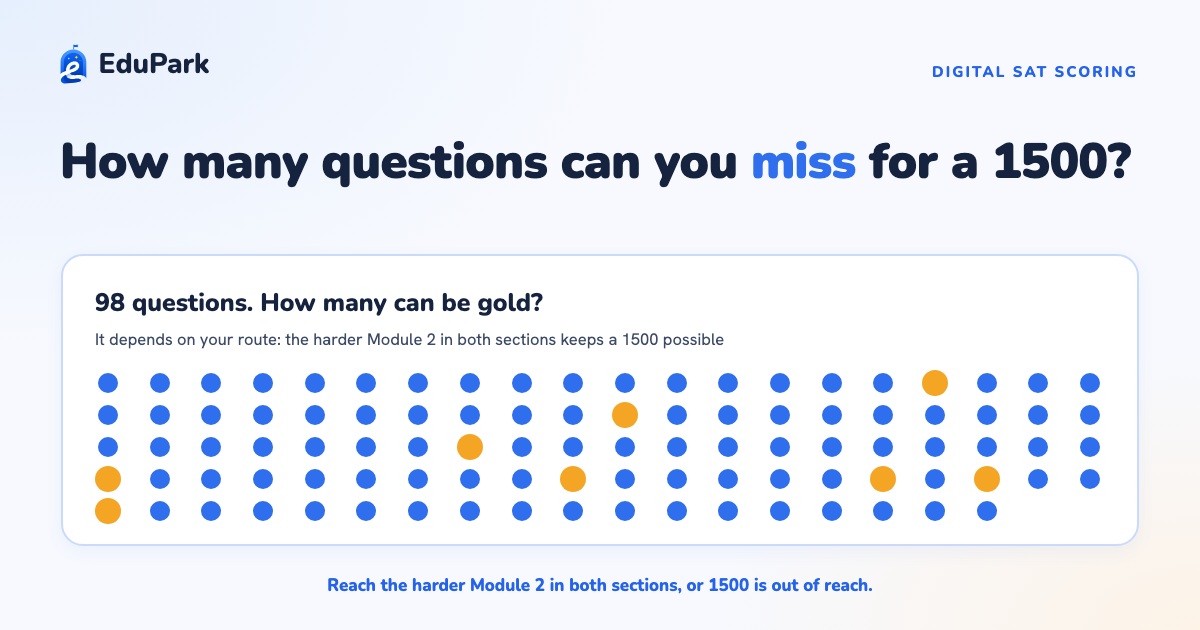
There is an official table for how many questions you can miss, but it covers the paper practice tests, not the adaptive one you'll sit, so treat any number from it as rough.
On the real test, the second module you get routed to decides whether a top score is possible at all. If you land in the easier one in either section, a 1500 is out of reach however few questions you miss.
Why the paper table only goes so far
College Board's paper practice tests each come with a scoring guide: count your correct answers, find that raw score, read off a section score. The score comes back as a range, with columns headed LOWER and UPPER.
The bigger limit is that the test it scores doesn't adapt. Each guide opens with the line "This scoring guide is for students who completed the paper version of this digital SAT practice test," and College Board calls those tests nonadaptive. On the digital test everyone takes the same first module, and how you do on it decides whether your second is harder or easier. College Board doesn't publish that cutoff. It also says two students who answer the same number of questions correctly "may earn differing section scores" depending on the difficulty of the ones they got right. On the real test a raw count isn't a score at all.
Can you still get a 1500 on the easier module?
No. The two sections have to add up to 1500, and since 800 is the most either can score, neither section can fall below 700.
Now look at what each module allows. College Board's scoring page shows it in a figure: the Lower Difficulty bars "extend from 200 to slightly above the benchmark in Math and to slightly higher above the benchmark in Reading and Writing," while the Higher Difficulty bars begin just below those benchmarks and "extend to the top limit of 800."
The benchmarks it refers to are College Board's College and Career Readiness Benchmarks: 530 in Math and 480 in Reading and Writing, unchanged when the test went digital. So the easier module tops out somewhere in the 500s. College Board doesn't publish an exact ceiling and the figure only says "slightly above," but it doesn't need to be exact. A 1500 needs at least 700 in both sections, and the easier module isn't close.
So reaching the harder module is what keeps a 1500 possible, and the first module is where that gets decided.
How to widen your margin
- Earn the hard module. First-module performance sets your ceiling for that section. Give it your most careful work, and never sandbag it hoping for an easier second half.
- Find your repeat mistake. Lost points often come from a few recurring errors. A short error log after each practice section is a quick way to find yours.
- Practice on something that routes. A static PDF can't reproduce module routing, so it can't show you which module you'd land in. Use College Board's Bluebook or EduPark.
What to aim at
Which module you reach decides whether a 1500 is available to you at all, and within that limit, every miss still costs you points. EduPark's full-length mock exams route you through modules the way the digital SAT does, so you find out which one you're on before test day rather than after.